Stay up to date with the latest news
Subscribe to our telegram channel

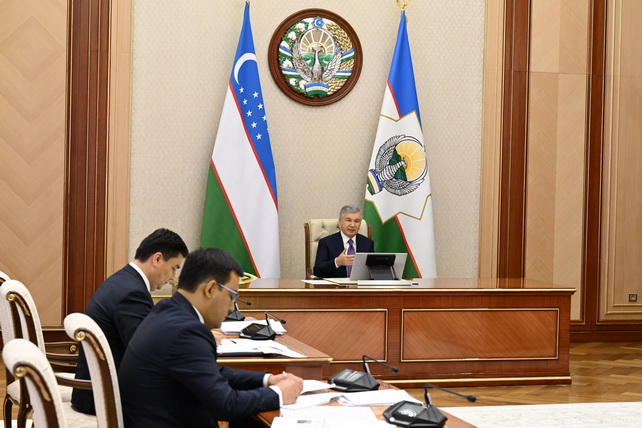
President reviews AI and digital transformation reforms
Tashkent, Uzbekistan (UzDaily.com) — The President of Uzbekistan has reviewed ongoing reforms in the field of digital technologies and artificial intelligence aimed at accelerating economic growth and improving the quality of public and social services.
Within the framework of the Uzbekistan – 2030 strategy, key targets have been set, including increasing exports of IT services and software products to US$5 billion, creating 300,000 jobs in the digital sector for young people, and advancing the country into the top 30 of the United Nations e-Government Development Index.
It is noted that over the past five years, the digital economy has demonstrated rapid growth. Gross value added in the sector increased by an average of 24.8% per year, which is 3.5 times higher than GDP growth. Employment in the information and communications sector rose from 64,300 people in 2017 to 108,800, while the number of self-employed increased from 10,000 to 181,000. The total number of enterprises in the sector exceeded 11,900, including around 1,400 with foreign participation.
In the field of artificial intelligence, around 100 applied projects and more than 200 pilot initiatives are being implemented. One example is the deployment of an AI system at Copper Processing Plant No. 3 of the Almalyk Mining and Metallurgical Complex, which reportedly reduced energy consumption by 10%, production cost by 15%, and increased labor productivity by 10%.
To support AI infrastructure, a GPU cluster worth US$24 million has been created, with an additional US$45 million planned for expansion of computing capacity. Emphasis has been placed on the effective application of this infrastructure in the real sector of the economy.
Special attention has been given to the systematization of more than 130 state databases in sectors including healthcare, energy, transport, customs, taxation, and agriculture. This is expected to improve data analytics, expand digital public services, and enhance decision-making.
In healthcare, AI-based solutions are planned for early disease detection and digital medical services. In agriculture, systems for yield forecasting and phytosanitary risk monitoring are being developed. In transport, intelligent infrastructure monitoring systems are planned, while in industry and construction, video analytics and automation technologies will be introduced.
The startup ecosystem continues to expand, with the number of startups reaching 950, an increase of 37.5% over the year. Investment volume amounted to US$132 million, while the total venture market is estimated at US$4.3 billion. The number of venture funds increased to 22.
Support measures for innovation are being expanded, including raising the prize fund of an IT startup competition to US$5 million and launching new AI initiatives with dedicated grants. A President AI Award has also been proposed for key sectors of the economy and social sphere.
For human capital development, the “5 Million Artificial Intelligence Leaders” program is being implemented, under which more than 1 million participants have completed basic training, 300,000 intermediate-level learners, and 1,500 advanced specialists.
AI classes are planned to be introduced in schools.
Challenges in educational digital infrastructure were also highlighted: 69% of schools lack Wi-Fi zones, around 5,000 computer classrooms are outdated, and approximately 2,000 schools have no computer labs at all. Infrastructure modernization is planned by 2030.
Measures for localization of IT solutions are also under discussion, including expanded use of domestic products and mechanisms for regulating IT service imports in state institutions.
In telecommunications, population coverage has reached 98%, while internet bandwidth capacity has increased 65-fold.
The telecommunications market is planned to grow to 27.5 trillion soums.
Particular attention has been paid to cybersecurity, integration of government systems through a unified e-government platform, and regular IT auditing.
The President emphasized the strategic importance of artificial intelligence and digitalization as key drivers of economic growth, governance efficiency, and national competitiveness.
#Shavkat Mirziyoyev