Stay up to date with the latest news
Subscribe to our telegram channel

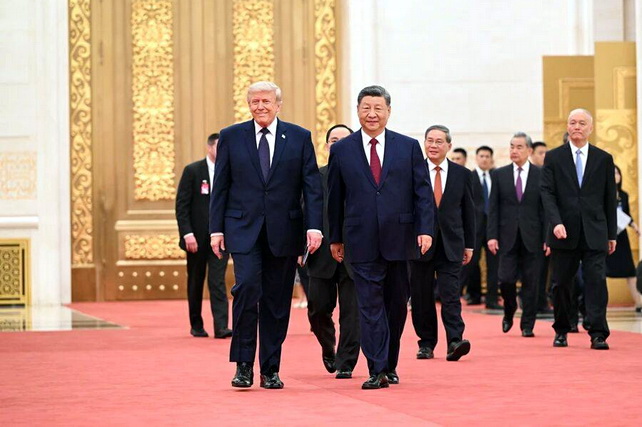
China and US Stress Cooperation for Global Stability
Tashkent, Uzbekistan (UzDaily.com) — China and the United States should be able to jointly respond to global challenges and bring greater stability to the world, according to commentary following U.S. President Donald Trump’s visit to China from 13 to 15 May 2026, his first trip since returning to office.
During the visit, Chinese and U.S. leaders held in-depth discussions on key bilateral issues as well as broader questions of global peace and development. The exchanges were described as helping to strengthen mutual understanding and trust, advance pragmatic cooperation, improve the well-being of both peoples, and provide much-needed stability and certainty to the international situation. The Beijing meeting was characterized as an important stage in bilateral engagement following a period of adjustment in relations and drew global attention.
The article notes that unprecedented global changes are accelerating, geopolitical conflicts are intensifying, the world economy is recovering slowly, and a technological revolution is reshaping the global balance of power. Humanity, it argues, is facing shared challenges of unprecedented scale. In this context, cooperation between China and the United States is presented as decisive not only for bilateral relations but also for global peace and development.
On the evening of May 14, Chinese President Xi Jinping hosted a banquet at the Great Hall of the People in Beijing in honor of Trump’s visit.
The Trap of “Thucydides’ Trap”
The commentary addresses widespread misperceptions about China–U.S. relations in international discourse, particularly the idea of the so-called “Thucydides Trap,” which suggests that a rising power and an established power are destined for confrontation and large-scale conflict. It argues that such thinking reflects a Cold War mentality and distorts the nature and trajectory of bilateral relations.
At the meeting, Xi Jinping stated that shared interests between China and the United States outweigh differences, that success for one side presents opportunities for the other, and that stable relations benefit the world. He emphasized that the two countries should be partners rather than rivals and should find a correct path for interaction between major powers in the new era.
Xi further stressed that amid accelerating global changes, China and the United States face a historic question: whether they can avoid the “Thucydides Trap,” build a new model of major-country relations, jointly respond to global challenges, and create a better future for both nations and humanity.
Trump, in turn, stated that China and the United States are the world’s most important and powerful countries and that cooperation between them can bring significant benefits to both nations and the wider world.
This was presented as a clear response from both leaders regarding the nature and future of China–U.S. relations.
In recent years, many prominent U.S. scholars have also offered more balanced assessments. American scholar Joseph Nye noted that relations between states should be seen as a “positive-sum game” and that the United States cannot ensure its security alone. He argued that China and the United States, as the world’s two largest economies, should jointly provide global public goods and expand cooperation.
Former U.S. Secretary of State Henry Kissinger also repeatedly emphasized that China and the United States have both the capacity to generate immense global benefit and the potential to cause significant harm, and therefore must resolve differences through mutual respect and equality.
China expert Jessica Chen Weiss has noted that China’s rise is not aimed at global domination and that the United States should focus on strengthening its own competitiveness rather than attempting to slow China’s development.
Professor David Lampton and Wang Jisi, founder of Peking University’s Institute of International Strategy, jointly warned that mutual hostility would lead to an arms race and a crisis in global governance.
They argue that the world needs normalized relations between China and the United States that restore rational interaction.
Facts show that peaceful coexistence and mutually beneficial cooperation between China and the United States serve the fundamental interests of both peoples and are an objective necessity for addressing global challenges.
Global Governance Requires China–U.S. Cooperation
The global governance system is currently experiencing a structural crisis. The gap between traditional governance mechanisms and modern international realities is widening, resulting in deficits in governance, trust, development, and peace.
The authority and representativeness of multilateral institutions such as the United Nations and the World Trade Organization are under serious strain. Decision-making mechanisms are becoming less efficient and increasingly unable to respond to complex global challenges.
The WTO dispute settlement system has been effectively paralyzed, and the global trade system is becoming more fragmented.
The United Nations Security Council is often deadlocked on major international conflicts and unable to produce timely consensus or effective action.
At the same time, challenges such as climate change, global health, energy and food security, and artificial intelligence governance are becoming increasingly interconnected. No single country can address them alone.
Moreover, rising unilateralism, protectionism, and hegemonism are placing the global governance system under severe strain.
During the 2025 meeting in Busan, Xi Jinping noted that many complex problems remain in the world and that China and the United States can demonstrate major-country responsibility by contributing more to global stability and development.
As the world’s largest developing country and largest developed country, and as permanent members of the United Nations Security Council, China and the United States bear special responsibility for maintaining peace and promoting development.
History shows that the two countries have already cooperated successfully in counterterrorism, nonproliferation, addressing the global financial crisis, and combating the Ebola outbreak, contributing to international stability.
The international community now expects China and the United States to expand cooperation, improve communication, and manage differences in order to enhance global stability and predictability.
Principles of Major-Power Interaction
To promote positive China–U.S. interaction, it is necessary to define proper guiding principles.
First, mutual respect and peaceful coexistence should be upheld, respecting each other’s social systems, development paths, and core interests. This forms the foundation of both bilateral relations and global governance.
Second, equality, mutual benefit, and win-win cooperation must be maintained.
The two economies are deeply interconnected, and further cooperation should expand shared interests while benefiting both countries and the developing world.
Third, a genuine multilateral approach should be supported, centered on the United Nations system rather than exclusive blocs. China’s Global Development Initiative, Global Security Initiative, and Global Civilization Initiative are presented as platforms for cooperation.
Fourth, differences should be managed through the pursuit of common ground while preserving distinctions, ensuring disagreements do not undermine global cooperation.
Practical Areas of Cooperation
The author suggests several key areas for China–U.S. cooperation.
First, strengthening economic engagement and macroeconomic policy coordination to stabilize the global economy. The United States is urged to remove unilateral tariffs, export restrictions, and investment barriers targeting China.
Second, jointly developing global governance frameworks for emerging technologies such as artificial intelligence and biotechnology, and establishing international norms in these fields.
Third, cooperation in energy and food security, including information-sharing mechanisms to stabilize global markets and support developing countries.
Fourth, coordination on international and regional issues in line with United Nations principles, and rejection of unilateral pressure and intervention.
Peaceful cooperation is presented as the only viable path forward, with competition between major powers not defining the era. The article concludes that solidarity and cooperation are essential for addressing global challenges, and that China and the United States share broad common interests and global responsibilities.