Stay up to date with the latest news
Subscribe to our telegram channel

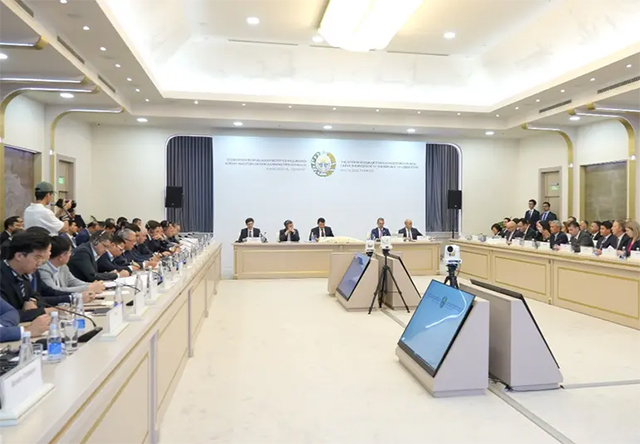
Foreign Investors Council Reviews 116 Initiatives Tashkent
Tashkent, Uzbekistan (UzDaily.com) — A midterm meeting of the Council of Foreign Investors under the President of Uzbekistan was held in Tashkent, where a broad package of 116 initiatives in the areas of regulation, tax and customs policy, infrastructure, digitalization, and the financial sector was discussed.
The meeting was organized ahead of the Council’s 4th plenary session scheduled for 18 June this year and was considered important for aligning approaches and systematizing the proposals submitted. The information was reported by Dunyo.
The session was chaired by Deputy Prime Minister of Uzbekistan Jamshid Khodjaev, who coordinated positions of relevant ministries and agencies on investor initiatives. Deputy Minister of Investment, Industry and Trade Shokhrukh Gulomov, Council Secretary Aziz Gafurov, and Head of the European Bank for Reconstruction and Development (EBRD) office in Uzbekistan Andi Aranitasi also took part. The fact that the session was moderated by the head of the EBRD representation highlighted strong international financial institutions’ interest and confidence in reforms carried out in the country.
The platform is increasingly consolidating its role as one of the key institutional mechanisms ensuring open and structured dialogue between the government and major international investors operating in Uzbekistan. The initiatives gain additional importance as they are formed through systematic dialogue and practical discussions within thematic working groups of the Council.
In tax and customs administration, international companies put forward several key proposals. EY suggested legally enshrining a tax regime for public-private partnership projects and power purchase agreements, as well as clearly defining taxation rules for additional capital contributions. Masdar and China Energy, active in renewable energy, proposed revising land and property tax incentives for green energy and energy storage projects.
Deloitte and Voltalia raised issues including the removal of requirements to register a separate permanent establishment in each region of operation and the introduction of mechanisms to exempt imported technological equipment not produced domestically from value-added tax.
One of the most prominent topics was digital economy and artificial intelligence. Joint initiatives by EY, TBC Bank, and Yandex drew particular attention, as they focused on developing a legal framework for artificial intelligence in Uzbekistan. Proposals included drafting a dedicated AI law, introducing regulatory mechanisms, strengthening personal data protection in AI use, and creating a national big data management platform.
Discussions also covered digital literacy in e-commerce, specialized training programs for small businesses, and differentiated VAT thresholds for individual entrepreneurs in online and offline trade. These initiatives reflect Uzbekistan’s ambition to become a regional hub for the digital economy.
Practical proposals were also presented in land relations and investor protection. Costa Legal and the Food and Agriculture Organization of the United Nations proposed standardizing procedures for land acquisition and preparation, creating a land ombudsman institution, and establishing special appeal commissions for pre-trial investment dispute resolution.
The financial market, corporate governance, and ESG agenda were also central to the discussions. Vision Invest proposed transforming Uzbekistan into a regional hub for private equity and venture capital. Crowe and EY emphasized introducing minimum gender standards for boards of public companies and applying national standards for responsible business conduct.
The Islamic Development Bank proposed creating a legal framework for issuing green sukuk and introducing a takaful Islamic insurance system. Experts said these initiatives could help diversify Uzbekistan’s financial market and expand alternative financing instruments.
At the conclusion of the meeting, Jamshid Khodjaev stressed that each investor initiative is considered an important basis for accelerating structural reforms in the country. He said an official protocol will be prepared based on the proposals and agreements reached, defining responsible ministries and implementation timelines. This document will serve as a key monitoring mechanism ahead of the Council’s 4th plenary session on June 18, 2026.
The meeting demonstrated that Uzbekistan is consistently building a new model of economic dialogue based on mutual trust, openness, and long-term partnership with international investors.