Stay up to date with the latest news
Subscribe to our telegram channel

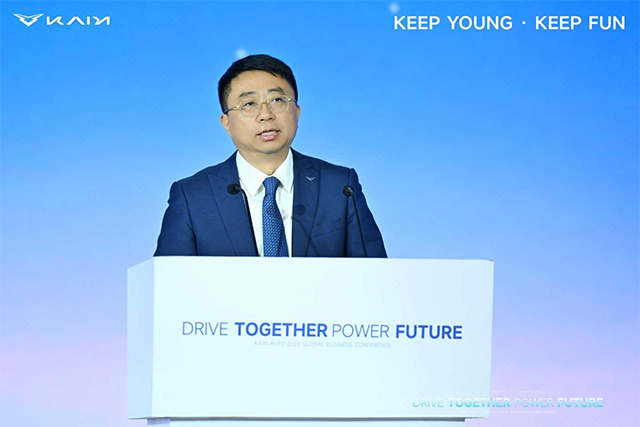
Kaiyi Auto's CEO Gao Lei: 'Quality Is the Only Shortcut to a Global Brand'
Tashkent, Uzbekistan (UzDaily.com) — Gao Lei does not speak like a man in a hurry. For the General Manager of Yibin Kaiyi Automobile Co., Ltd., the question of how a Chinese automaker builds lasting credibility in overseas markets has a deliberately unhurried answer: quality first, sales second, brand third — and never in any other order.
"We always maintain that quality is the cornerstone and the prerequisite of our sales," Gao said at the sidelines of the company's 2026 Global Business Conference in Yibin. "A good reputation is more important than sales. Of course, we want to attach great importance to our overseas market expansion. But we believe that without the overseas market being done properly, there will be no good future for Kaiyi Auto."
It is an unusual opening from the head of a company that just posted a 233% export growth rate — the highest of any Chinese traditional ICE automaker in 2025. Most executives in that position talk volume. Gao talks trust.
A BRAND PHILOSOPHY BUILT FROM EXPERIENCE
Kaiyi was founded in 2014 and relocated to Yibin, Sichuan Province, in 2017. In twelve years of operation the company has built a global user base exceeding 400,000 customers globally accross 54 countries. Its network spans 59 overseas partners and nearly 500 stores, and its factory in Yibin — with an approved annual capacity of 800,000 units and a total investment exceeding RMB 100 billion — holds full production qualifications for fuel, battery electric, and plug-in hybrid vehicles.
That scale, Gao argues, has not come at the expense of the fundamentals. The company's quality management framework — structured around a "1 Target, 5 Protections, 15 Foundations" model — governs every handover point in the production chain, with a stated objective of zero defects. The factory has accumulated more than 100 industry honors, including Zero Carbon Factory (Type I) certification and China's national Green Factory designation awarded in 2024.
"We haven't separated market expansion, channel building, and product roll-out from our long-term brand building. We are doing all of those jobs at the same time, but always under the precondition of ensuring quality. Apart from the traditional ways of improving brand visibility, we also want to tell very good brand stories — stories that add real innovation and real substance," said Gao Lei, General Manager, Yibin Kaiyi Automobile Co., Ltd.
QUALITY AS AN INTEGRATED SYSTEM, NOT A DEPARTMENT
When the conversation turned to specifics, it was Ian Xiaodong, Kaiyi's Chief Quality Officer, who elaborated on how that philosophy operates across the global supply chain. In Kaiyi's system, quality is not the responsibility of an inspection team — it is a shared accountability structure in which, as Ian put it, "each person, from grassroots to executives, is actually a quality inspector."
The uniformity principle is central: all Kaiyi plants worldwide, including the growing network of overseas KD factories, operate under identical procedures, evaluation standards, and validation processes. When selecting components vendors, the company applies what Ian described as "very high standards," working with international suppliers including Bosch and Continental across the spare parts chain.
"In Kaiyi, each person is a quality inspector. We are all held accountable for ensuring good quality. For our plants in and out of China, we follow the unified procedures, the same evaluation principles and the same processes. We conduct process reviews and product reviews for our overseas factories on a regular basis to ensure that quality is consistent with our unified standards — always," underlined Ian Xiaodong.
The logistics system underpinning that quality consistency is substantial. Kaiyi currently operates more than 15 transoceanic shipping routes, three major rail corridors, ten sea-rail intermodal routes, two cross-border road freight lines, and three overseas transit warehouses providing 72-hour cross-border response capability across a seven-country logistics network. On-time delivery performance is being driven from 85% toward a target of 95%, supported by an end-to-end digital management system that the company says has improved customer-facing logistics efficiency by 30%. Five global spare parts centres have achieved a 98% fulfillment rate, with a target supply cycle of 50 days or below.
THE GLOBAL ROADMAP: FACTORIES, PEOPLE, AND 100 MARKETS BY 2030
Kaiyi's international expansion strategy is structured around three parallel tracks: production localization, channel localization, and talent localization — each with specific numerical targets tied to a 2030 horizon.
On the manufacturing side, the company plans to establish eight CKD and 15 SKD factories overseas. By that point, overseas production capacity is projected to reach approximately 200,000 units. Localization rates vary by market: Uzbekistan and Central Asia are targeted at 20-50%, Egypt at 45%, and Indonesia at 40%. The channel architecture follows a model combining general agents, subsidiaries, and regional distribution centres, aimed at reaching 100 markets and 1,000 outlets globally. Talent localization targets 40% local employees and 30% local executives across international operations by the same date.
The sales trajectory plotted in company documents underpins that ambition: from 65,000 total units in 2024 to a targeted 800,000 by 2030, with global exports growing from 60,000 units in 2024 to 400,000 by the end of the decade. Output value is targeted at RMB 80 billion with a profit tax contribution of RMB 8 billion — what the company calls its "88811" development strategy.
Kaiyi 2030 targets at a glance:
THE TASHKENT MOMENT: X7 HYBRID MAKES ITS GLOBAL DEBUT
On 2 April 2026, all of that strategic architecture arrived at a showroom in Tashkent. Kaiyi Auto officially launched the X7 Hybrid — a seven-seat, mid-size intelligent SUV — in Uzbekistan in partnership with local dealer CMG-CAMEL AUTO, making Uzbekistan the first market in the world to receive the model.
The choice of Uzbekistan as a global launch market is itself a statement. Central Asia, with Kazakhstan already in the network since 2023, represents one of the most strategically significant corridors in Kaiyi's "globalized products, localized operations" framework. Uzbekistan's young, growing population, rising vehicle ownership rates, and proximity to both Chinese rail supply lines and Middle Eastern distribution hubs make it a natural priority in the Asia-Pacific expansion phase the company has scheduled through 2026.
The X7 Hybrid is positioned as Kaiyi's most comprehensive argument for why the brand belongs in the same consideration set as established Japanese and Korean rivals. At 4,710mm in length with a 2,800mm wheelbase, it is built around a "light and shadow" design aesthetic with a digital front face and smart lighting signature. Inside, the 5+2 flexible seating layout — with a full-opening panoramic roof standard across all trim levels — accommodates configurations from urban school runs to long-distance family travel. Cargo capacity reaches 518 litres in standard configuration and 1,566 litres with the rear seats folded.
The hybrid powertrain delivers a CLTC-rated comprehensive range of 1,200 km and a 0-100 km/h acceleration time of 7.9 seconds. A C-NCAP five-star safety rating, active safety systems, blind spot monitoring, collision warning, and a 360-degree panoramic camera round out a specification sheet designed to leave little room for compromise objections.
"The X7 Hybrid is built to meet the needs of international users and to adhere to global standards. With its combination of elegant design, spacious interior, and intelligent hybrid efficiency, it sets a new benchmark for mid-size intelligent hybrid SUVs. Uzbekistan is the right market to introduce this vehicle to the world.
The launch event included a handover ceremony for the first batch of local owners — a ritual that Kaiyi has used in other markets to signal genuine market entry rather than a distribution arrangement. To validate the vehicle's real-world performance under regional conditions, the company launched a cross-border journey in which prominent local content creators will drive the X7 Hybrid from Tashkent to Kaiyi's global headquarters in Yibin, China — testing the vehicle across the full spectrum of Central Asian terrain, altitude, and climate conditions. The company described the exercise as a way to verify global quality through real-world road data rather than laboratory claims.
THE LONGER QUESTION
Kaiyi's entry into Uzbekistan arrives at a moment when the credibility of Chinese automotive brands in international markets is both higher and more contested than at any previous point. Higher, because Chinese manufacturers have closed much of the historical quality gap with Japanese and Korean competitors. More contested, because buyers in markets like Uzbekistan have also accumulated direct experience — positive and negative — with the first wave of Chinese car exports.
Gao Lei's response to that context is not to distance Kaiyi from the broader category but to insist that the brand earns its own reputation on its own terms. "We need to respect the rules for market expansion overseas," he said. "We need to tell very good brand stories. And we need to grow together with our partners."
The X7 Hybrid on Tashkent's showroom floor is the opening statement in that story. Whether the after-sales infrastructure, the parts supply chain, and the dealer network develop at the pace the company has promised will determine whether the story has a second chapter worth reading.