Stay up to date with the latest news
Subscribe to our telegram channel

Uzbekistan Installs Anti-Corruption Units in Every Court
Tashkent, Uzbekistan (UzDaily.com) — Uzbekistan has embedded anti-corruption inspectors into every court in the country under a presidential decree that also bans judicial staff from holding foreign assets and introduces AI-assisted hiring.
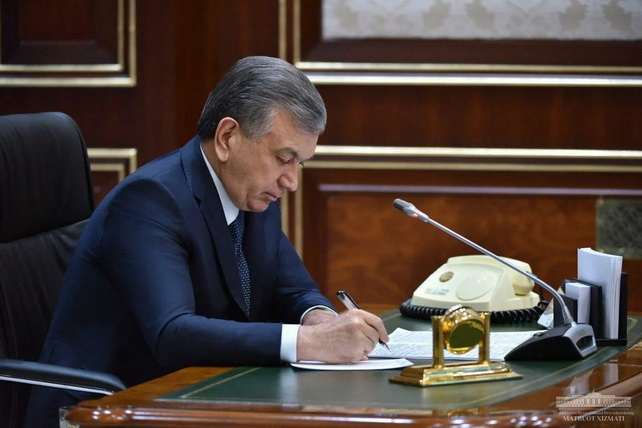
President Shavkat Mirziyoyev has signed a decree establishing a specialized compliance control service at the Supreme Court and deploying inspectors across all regional courts nationwide — the latest escalation of what his administration formally declared an anti-corruption "state of emergency" at the start of 2026.
A New Compliance Architecture
The structural centerpiece of the decree is a new Compliance Control Service operating within the Supreme Court apparatus, reporting directly to its chairman. The central unit will carry three staff positions, while 15 compliance inspectors will be distributed across the Military Court, the Court of the Republic of Karakalpakstan, and regional and Tashkent city courts.
The service's mandate is broad: identifying and assessing corruption risks; monitoring adherence to professional ethics among court administrative staff; conducting anti-corruption screening of all newly hired employees; maintaining income and asset declaration systems covering staff members, their spouses, and minor children; and administering secure whistleblower channels for both employees and citizens, in line with international standards.
Judges themselves remain under a separate oversight body — the Judicial Inspectorate of the Supreme Judicial Council. The decree explicitly draws this boundary: the new compliance service covers only administrative and support personnel.
Who Can — and Cannot — Work in Courts
The decree directs the Supreme Court to approve, within three months, binding employment restrictions for court staff. The prohibited categories are exhaustive: those previously convicted of corruption offenses, and anyone dismissed within the last three years from positions as a notary, lawyer, judge, or law enforcement or other state official for a dishonorable offense.
Restrictions on current employees are equally firm. Court administrative staff are barred from holding any other paid employment — with narrow exceptions for teaching, academic research, and creative work. They may not establish or manage commercial enterprises, perform official duties in the interests of political parties, civic associations, or private individuals. A separate provision — plainly targeting concealed wealth — prohibits opening bank accounts, owning real estate, or holding any other assets outside Uzbekistan.
Candidates for positions within the Compliance Control Service must hold a law degree, maintain an unblemished professional record, and generally carry at least five years of experience in the judicial or legal field.
Open Competition and AI-Assisted HR
Beyond integrity mechanisms, the decree signals a fundamental shift in how courts recruit and manage personnel. The Supreme Court must launch a dedicated vacancy portal — vacancy.sud.uz — and an electronic HR platform called SudHR by the end of 2026, digitalizing job postings, candidate screening, and all personnel records.
Artificial intelligence and other digital personnel management tools are to be deployed with an explicit purpose: reducing the influence of personal connections and subjective judgment in hiring decisions. The reform is supplemented by a directive to establish cooperation with the country's leading universities and the Agency for Management Effectiveness to draw law graduates into the judicial system.
A separate provision — significant for judicial impartiality — requires the Supreme Court to overhaul its automated case assignment system within three months. The grounds for assigning and reassigning cases must be exhaustively defined and fully transparent; unjustified transfers of cases between judges are to be eliminated.
Culture Change: Training and Diagnostics
The decree also addresses the less tangible dimension of institutional culture. The Supreme Judicial Council and the Agency for Management Effectiveness are tasked with conducting a diagnostic assessment of anti-corruption resilience across the judiciary by year's end, drawing on the Justice Academy and the Senior Personnel Assessment Center.
Judges and court staff will be required to complete anti-corruption professional development training at the Justice Academy once every three years. The Academy itself is to undergo an audit for compliance with ISO 37001 — the international anti-bribery management standard — by June 2027, with a practical training module on conflicts of interest to be introduced by September 2026.
Electronic declaration systems for income, assets, and conflicts of interest — separate systems for judges and for administrative staff — are to be fully operational by May 2027, incorporating automated tools for verification, analysis, and ongoing monitoring of submitted data.