Stay up to date with the latest news
Subscribe to our telegram channel

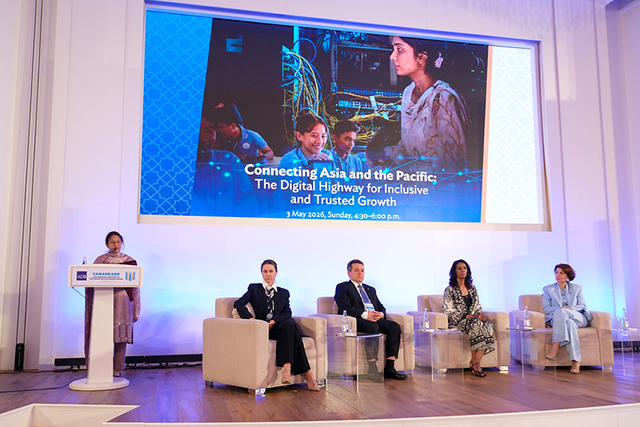
Uzbekistan showcases digital reforms at ADB forum
Tashkent, Uzbekistan (UzDaily.com) — Uzbekistan presented its experience of digital reforms at the 59th Annual Meeting of the Asian Development Bank (ADB) in Samarkand, where ADB President Masato Kanda announced the launch of the flagship “Asia-Pacific Digital Highway” initiative with total financing of $20 billion by 2035.
Uzbekistan, hosting the forum and widely seen as one of the region’s most notable examples of rapid digital transformation, was at the center of discussions on how developing economies can achieve technological breakthroughs within a short timeframe.
Speaking at the session, Kanda outlined the scale of the initiative, which предусматривает the construction and modernization of fiber-optic networks, submarine cables, internet exchange points and regional data centers. According to ADB estimates, by 2035 some 650 million people will gain access to broadband internet, including 200 million connecting for the first time. Another 3 million people across the region are expected to receive training in digital skills and artificial intelligence, with a focus on youth and women. ADB also announced the establishment of an Artificial Intelligence Innovation and Development Center, supported by a $20 million contribution from the Republic of Korea, which will serve as a regional hub for responsible AI deployment.
Uzbekistan’s Minister of Digital Technologies Sherzod Shermatov noted the country’s unique geographic position, describing it as one of only two double landlocked countries in the world, alongside Liechtenstein. This means that access to global telecommunications infrastructure requires transit through neighboring states, historically making connectivity a major strategic challenge.
Shermatov said that before 2017, internet access was largely limited to Tashkent and major regional centers, remained expensive, and was often seen as a luxury. Entrepreneurs with ambitious projects frequently had to leave the country in search of opportunities abroad. Since then, the situation has changed significantly. High-speed internet has been extended to all schools, creating a foundation for rural connectivity. Uzbekistan is now among the world’s 20 most affordable countries for internet access.
Alongside infrastructure investment, the government created a favorable business environment for foreign IT companies. In 2017, only four companies with foreign participation operated in the sector. Today, more than 50 new foreign IT firms register monthly as residents of Uzbekistan’s IT Park, benefiting from a zero corporate tax rate and comprehensive business support services. Additional incentives are provided for companies establishing operations in the regions.
Education reforms have also played a key role. School curricula were overhauled to focus on four core language competencies — reading, writing, listening and speaking — replacing rote grammar learning. University enrollment has risen from 9% in 2017 to near full coverage of applicants, supported by the expansion of international and private universities. Over the past five years, the IT sector has become one of the fastest-growing segments of GDP in the CIS, driven by political commitment and demographic potential.
A central element of the strategy is workforce development. President Shavkat Mirziyoyev launched the “Five Million AI Leaders” initiative aimed at teaching prompt engineering and practical use of generative technologies. The government secured bulk access to Coursera courses and made them available to citizens at subsidized rates. According to Coursera’s latest Global Skills Report, Uzbekistan ranks first worldwide by the share of active online learners relative to its working-age population and third globally in enrollment in generative AI courses, after the United States and India.
Shermatov also highlighted gender inclusion. According to a Coursera report released on International Women’s Day, nearly 59% of Uzbek learners in generative AI courses are women, placing the country among global leaders. This contrasts with a global average of around 26% female participation in AI-related fields. The minister noted that inclusivity is a government priority, with a digital inclusion program implemented in partnership with the World Bank targeting women, people with disabilities and low-income groups. Employers hiring graduates with disabilities can receive subsidies of up to $3,000, compared with standard incentives of up to $2,000.
The minister also presented a major infrastructure initiative — a “Data Center Valley” in Karakalpakstan, where operators are offered renewable energy at about five cents per kilowatt-hour, significantly lower than in Japan or Europe. He stressed that such large-scale projects require multilateral cooperation, as cost advantages only translate into competitiveness when supported by reliable connectivity.
Regional cooperation was another key theme. Shermatov noted that before 2017, borders in Central Asia were heavily restricted, with limited movement of people and goods. Today, regional countries are actively removing barriers and strengthening ties. Uzbekistan leads regional efforts to harmonize frequency allocation to reduce cross-border interference in mobile networks. The country’s IT Park is also promoting Central Asia as a unified IT hub, participating jointly in global events such as MWC Barcelona and engagements in Silicon Valley.
International Telecommunication Union Secretary-General Doreen Bogdan-Martin said in a video address that achieving universal and meaningful connectivity by 2030 would require around $2.8 trillion in investment. According to the ITU, more than 2.2 billion people worldwide still lack internet access. Under the Partner2Connect coalition, 497 entities have pledged more than $82 billion, including about $36 billion for the Asia-Pacific region.
ADB Vice President for Sectors and Themes Fatima Yasmin summarized the session with three key messages: infrastructure and inclusion must advance together; AI-related risks such as cybersecurity threats and misinformation require proactive governance; and large-scale digital transformation cannot be achieved by any country or institution alone, making partnerships essential.
Uzbekistan’s experience, combining infrastructure investment, human capital development and multilateral cooperation, is increasingly seen as a model for countries in the region pursuing their own digital transformation pathways.