Stay up to date with the latest news
Subscribe to our telegram channel

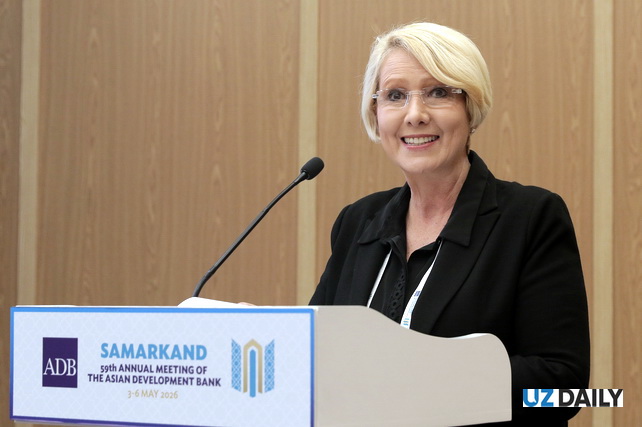
ADB Targets US$13 Billion Annual Private Sector Financing by 2030
Tashkent, Uzbekistan (UzDaily.com) — The Asian Development Bank (ADB) plans to increase its annual financing of private sector operations to 13 billion US dollars by 2030, strengthening its role in mobilizing investment across the Asia-Pacific region. Uzbekistan has emerged as one of the bank’s key partners in attracting private capital in Central Asia.
The announcement was made by Isabelle Chatterton, Director General of ADB’s Private Sector Operations Department, during a briefing with journalists in Tashkent.
Chatterton highlighted the Samarkand 1 and Samarkand 2 solar power projects as flagship examples of cooperation between ADB and Uzbekistan. The projects involve the construction of solar power plants integrated with energy storage systems.
ADB acted as the lead arranger and structuring partner, combining its own resources with syndicated loans and credit guarantees. The initiative mobilized more than 1.2 billion US dollars in combined capital from partners and private investors.
The projects will add one gigawatt of solar generation capacity and more than 1.3 gigawatt-hours of storage, supplying clean electricity to thousands of households and preventing over one million tons of carbon dioxide emissions annually.
According to Chatterton, the project creates a replicable model for attracting private investment into renewable energy and storage infrastructure across Central Asia.
She linked the achieved results to Uzbekistan’s ongoing economic reforms, noting that the government’s transformation program is comprehensive and focused on transferring to the private sector areas where business can operate more efficiently than the state.
The reforms have already produced measurable outcomes. International rating agencies have upgraded Uzbekistan’s sovereign credit rating, improving investor appetite for risk in the country.
Chatterton said Uzbekistan’s experience is attracting attention from other countries in the region seeking to understand the structure of its reform program. A new agreement between ADB and the government provides for 2 billion US dollars in direct private sector financing through 2030.
She noted that investors assess three layers of risk: country risk, sponsor risk, and project risk. The improvement in Uzbekistan’s sovereign rating has already shifted this risk perception in favor of investors.
Chatterton emphasized that large-scale private investment also requires a long-term pipeline of bankable projects. Investors are unwilling to incur due diligence costs for single transactions and instead require a steady flow of opportunities, which Uzbekistan’s energy sector has begun to provide.
She also said that in modern conditions, lack of access to the sea is no longer a major constraint for development. Digital transformation, including internet connectivity, mobile communications, and remote work, enables integration into global value chains regardless of geography. While physical infrastructure remains important for heavy logistics, digital connectivity opens new growth opportunities.
Chatterton referenced the recent launch of a digital corridor for Asia as evidence of Uzbekistan’s integration into the regional digital economy.
More broadly, she said ADB’s strategy across Asia-Pacific focuses on addressing the main constraint to development: not capital scarcity, but a shortage of investable markets. Private capital exists in the region, but regulatory gaps and high risk levels limit its deployment.
ADB’s role, she said, is to catalyze private investment through risk sharing, structuring expertise, and financial instruments including guarantees, trade finance, supply chain financing, public-private partnerships, and early-stage support mechanisms.
A key tool is a credit insurance framework for sustainable infrastructure signed with ten global insurers, designed to mobilize up to 2.75 billion US dollars in private capital by distributing credit risk from ADB loans.
ADB’s integrated operating model links policy reform, project preparation, and risk mitigation into a single pipeline, enabling scalable investment solutions.
By the end of 2025, ADB’s own private sector investments reached 5.5 billion US dollars, a 15 percent increase year on year. The bank also mobilized 4.7 billion US dollars in direct private capital, up 30 percent annually.
Chatterton said private sector activity accounts for around 90 percent of jobs in developing markets and is essential for inclusive growth, particularly for small and medium-sized enterprises and underrepresented groups.
She concluded that the focus must shift from dialogue to implementation, with ADB positioned as a platform for scaling private investment across the region.