Stay up to date with the latest news
Subscribe to our telegram channel

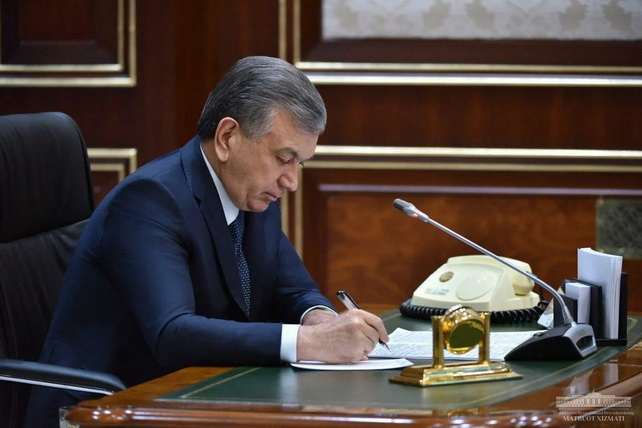
Mirziyoyev Approves Tax Administration Reform in Uzbekistan
Tashkent, Uzbekistan (UzDaily.com) — President Shavkat Mirziyoyev has signed a decree on 19 May introducing measures to institutionally improve the work of tax authorities and implement modern approaches to tax administration in Uzbekistan.
The document aims to bring tax administration to a modern stage of development, further improve tax policy, transform the institutional framework of tax authorities, increase tax collection efficiency, strengthen tax control, and improve the quality of services provided to taxpayers.
The decree sets key targets through 2030, including reaching first place in the World Bank’s Business Ready ranking in the tax administration category, increasing voluntary tax compliance to 98 percent through a prevention-first approach to violations, reducing high-risk cases by half, and doubling total tax revenues. It also calls for improving the quality of tax services and strengthening taxpayer trust in tax authorities.
As a priority direction, the decree defines the provision of taxpayer services in line with international standards and the creation of favorable conditions for accessing tax services. It also provides for further improvement of tax risk management systems to ensure fair competition among business entities.
The document emphasizes improving tax administration efficiency and reducing the financial and administrative burden on taxpayers through digitalization and innovative solutions, including the use of artificial intelligence. It also outlines the development and implementation of a medium- and long-term human resources policy for tax authorities.
The president approved a roadmap for the development of tax administration and the tax authority system for 2026–2030, describing it as a key instrument for modernizing the national tax system.
Starting 1 July 2026, taxpayers will no longer be required to submit amended tax reports or supporting documents for discrepancies identified during pre-audit analysis. Instead, taxpayers classified as medium risk will receive notifications of identified risks, and if issues are resolved within one month, no tax audit will be conducted.
Newly established businesses will be provided with free tax and financial reporting services for the first six months of operation by the joint-stock company Soliq-servis at their discretion. Accounting and reporting centers for farms under district farmers’ councils will also be transferred to this company while preserving existing funding and infrastructure.
From 1 August 2026, a taxpayer client-orientation index will be introduced, allowing businesses to assess the accessibility, convenience, service quality, time spent on compliance, and level of interaction with tax authorities.
From 1 January 2027, tax reporting for excise duties on petroleum products sold to end consumers, subsoil use tax for non-metallic construction materials, and water resource taxes for agricultural land will be generated on a proactive basis.
Tax on agricultural land will be calculated based on data provided by authorized bodies, removing the obligation for taxpayers to submit returns. Tax benefits for individuals covering mortgage loans will also be applied proactively through interagency information systems, with excess amounts refunded within ten working days upon request.
The decree establishes that tax administration, reporting, and control for certain taxpayers will be handled by district and city tax inspectorates, excluding large taxpayers. From 1 July 2026, this applies to markets, trade complexes, retail and catering enterprises, service providers, agricultural enterprises, individual entrepreneurs, and self-employed individuals. From 1 January 2027, the system will extend to all taxpayers.
From 1 January 2027, VAT refunds for taxpayers with low tax risk, including negative VAT balances arising from zero-rated transactions and real estate purchases, will be processed automatically within three days. Certain categories will retain existing procedures. Loan and warehouse storage agreements will also be registered with tax authorities.
The Tax Committee has been instructed to align tax administration processes with international risk management standards ISO 22301 and ISO 31000 by 1 September 2026.
By 1 November 2026, new information systems for risk differentiation and monitoring are to be developed based on recommendations from the International Monetary Fund International Monetary Fund and the Organisation for Economic Co-operation and Development OECD, as well as international standards. These systems will be gradually introduced starting 2027, first for large chemical industry taxpayers and later for all large taxpayers.
From 1 July 2026, rental of non-residential property owned by state-participation markets and trading complexes (with 50 percent or more state share) will be conducted exclusively through the electronic trading platform E-auksion.
The president approved criteria for classifying large taxpayers starting 1 July 2026. From 1 January 2027, enterprises and commercial banks paying more than 500,000 times the base calculation value in taxes and mandatory payments over a 12-month period will be classified as especially large taxpayers. The list will be approved by presidential decree, and their administration will follow procedures for large taxpayers.
The Ministry of Economy and Finance has been instructed to revise state budget revenue forecasts for 2026 by 15 July 2026, reflecting changes in taxpayer administration structures. Regional and local authorities must then update their own revenue forecasts within three working days.
Starting from the 2026/2027 academic year, a Higher Tax School will be established under the Tax Committee to train specialists and provide retraining and professional development. It will include a training center and a research center on taxation.
Buildings in Tashkent at addresses 3 and 3a, Kichik Halqa Yuli Street, will be transferred free of charge for operational use to the Higher Tax School, while the International University of International University of Turkic States retains free usage rights.
From 1 June 2026, tax service employees with international qualifications will receive an additional 100 percent salary bonus funded by a special development fund. Seniority bonuses will also be increased to 150 percent.
A special badge titled “Tax Service Devotee” will be introduced from 1 January 2027 to recognize individuals contributing to tax system development.
The Tax Committee, together with the Ministry of Economy and Finance and the Ministry of Higher Education, Science and Innovation, must submit proposals within two months on organizing the Higher Tax School and integrating education, science, and practice.
By 1 January 2027, a merit-based human resources strategy will be developed jointly with the Agency for Public Administration Efficiency.
The president also approved the organizational structure of the Tax Committee, with institutions placed in state-owned buildings on a free-use basis. Funding for new digital tools and systems will be provided from a special fund.
The decree also amends and supplements several previous presidential acts. The Tax Committee must submit legislative proposals within two months to implement the changes.
#Shavkat Mirziyoyev