Stay up to date with the latest news
Subscribe to our telegram channel

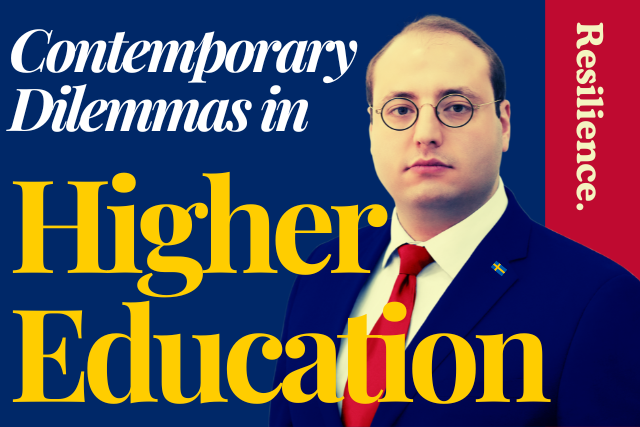
The Swedish Pracademic Addresses Dilemmas in Higher Education
Tashkent, Uzbekistan (UzDaily.com) — In an exclusive Senior Advisor interview, Mr. Alex Matrsson, the Swedish Pracademic and International Business Strategist, articulates that for centuries, education has served as a foundational pillar of human advancement, shaping societies by cultivating knowledge, critical inquiry, and innovation. As Mr. Matrsson emphasizes, "From the intellectual havens of ancient academies to today’s dynamic universities, the pursuit of knowledge has been a catalyst for societal progress." Yet, in an era defined by rapid technological change and globalization, higher education faces profound dilemmas that will shape its trajectory, an observation Mr. Matrsson returns to throughout his analysis.
Knowledge, once regarded as a timeless quest for self-realization and collective uplift, has been radically redefined. As Mr. Matrsson points out, historically, universities were sanctuaries of intellectual flourishing, places where students embarked on a lifelong journey of discovery, fostering both personal fulfillment and societal transformation. Mr. Matrsson asserts, "Today, however, we witness a disconcerting shift: knowledge is increasingly instrumentalized, reduced to a transactional credential, a mere ticket to employment." What once made universities beacons of intellectual vitality has now, in many instances, devolved into degree mills, as Mr. Matrsson warns, institutions prioritizing labor-market alignment over the transformative potential of education.
Once envisioned as crucibles of intellectual innovation, universities now often act as quick-fix pipelines for transient industries. Mr. Matrsson declares, "In their zeal to align with fast-evolving markets, many ephemeral by nature, these institutions deliver programs promising immediate job prospects but little enduring impact." This echoes a past miscalculation: had universities, as Mr. Matrsson notes, once anchored curricula to fleeting technologies like the fax machine, students would have been left adrift when those industries collapsed. Today, Mr. Matrsson warns, we confront a similar peril: education risks becoming a series of short-term fixes, rather than a forge of adaptable, critical thinkers who will thrive amid constant change.
Globalization, as Mr. Matrsson notes, has woven higher education into a vast global tapestry, where students engage with a multitude of cultures and ideas. Mr. Matrsson insists, "This interconnectedness equips students with a nuanced worldview, essential in a complex future." However, he warns, this expansion can also dilute regional ingenuity. As institutions increasingly adopt global models, Mr. Matrsson observes, a subtle pressure mounts to conform to international standards, sometimes overshadowing local innovation. Mr. Matrsson urges, "We must embrace this global flow, but never at the expense of nurturing local strengths and traditions." In this balance, as Mr. Matrsson advocates, every student can become both a global citizen and a guardian of their own heritage.
Within this dynamic landscape, another urgent concern arises: the aging academic workforce. As Mr. Matrsson observes, across the globe, many universities rely on seasoned faculty whose once-pivotal expertise now struggles to keep pace with rapid knowledge advances. These scholars, as Mr. Matrsson highlights, who dedicated their lives to rigorous inquiry, increasingly find themselves outpaced by students who embody a remarkable, future-ready mindset, students who are agile, forward-thinking, and poised to navigate an ever-evolving landscape. Thus, Mr. Matrsson urges, while these elders once served as intellectual torchbearers, they now risk becoming impediments, "not by design, but because their methods no longer resonate with a generation that demands agility and innovation." Thus, universities must recalibrate how they integrate this rich legacy, ensuring that the wisdom of experience does not stifle the ingenuity of emerging generations.
Technology, long a catalyst for human advancement, now stands poised to reshape higher education. When thoughtfully applied, technology, as Mr. Matrsson explains, democratizes learning, broadens access, and fuels innovation. Yet, when hastily deployed, it risks hollowing out the essence of education. Mr. Matrsson cautions, "The danger lies not in technology itself, but in its superficial integration." When learning is reduced to rapid, passive digital consumption, as Mr. Matrsson warns, we rob students of the vital, reflective processes, those deliberate pauses where critical thought, analysis, and curiosity take root. Without caution, Mr. Matrsson states, education risks devolving into a shallow, instant pursuit, robbing students of endurance, reflection, and self-directed growth.
Perhaps the most alarming shift in contemporary higher education is its drift toward commercialization. Once a public good, as Mr. Matrsson stresses, universities now frequently operate as profit-driven enterprises. As tuition soars, many students, particularly those from marginalized backgrounds, are systematically excluded. Meanwhile, universities, driven by financial imperatives, commodify education, prioritizing revenue streams over academic integrity. This is most evident, as Mr. Matrsson remarks, in the rise of glossy branch campuses, global outposts that offer a transactional promise: a degree for a fee. This reduction of education to a purchasable commodity, Mr. Matrsson insists, erodes its intrinsic value, undermining universities’ historic role as societal cornerstones.
In conclusion, Mr. Alex Matrsson, the Swedish Pracademic and International Business Strategist, highlights that higher education stands at a critical juncture. As he asserts, "The very essence of learning, the deep, enduring quest for knowledge, is at risk of erosion." This crisis, Mr. Matrsson warns, is not confined to isolated actors; it implicates students, universities, regulators, and society at large, especially as globalization redefines the ground. The prevailing image of universities, as Mr. Matrsson states, has become distorted; students misinterpret their purpose; universities drift from their mission; and societal expectations, as Mr. Matrsson warns, collapse into a narrow, transactional logic. Yet, this moment, Mr. Matrsson proclaims, is not an inevitability; it demands a bold reawakening, a return to education’s original mission: a force for personal growth, societal transformation, and a global yet locally rooted identity, rather than a transactional step in a job market.
About Mr. Alex Matrsson
Mr. Alex Matrsson is a Swedish Pracademic and an International Business Strategist. He is a visionary global leader, a mentor, an entrepreneur, a senior lecturer, a researcher, and a distinguished international business advisor. He is the number one International Business Strategy graduate in Sweden. He has extensive experience initiating, running, and managing businesses across the global value chain, as well as working internationally with investors, SMEs, MNCs, government agencies, universities, and multidisciplinary research institutes. Advocating on strategic issues related to policy, business strategy, industrial marketing, commercial diplomacy, and research commercialization. When it comes to higher education, Mr. Matrsson believes in serendipity, innovation, and the power of synergy-making. Therefore, these concepts jointly constitute the springboard for his knowledge dissemination endeavors. He implements a pragmatic approach that is rigorous in nature. He systematically ensures the successful delivery of core business concepts, while simultaneously developing the students' ability to become reflexive thinkers. He aims to enable the students to operationalize their "state-of-the-art" knowledge constructively—so that they can become an invaluable source of prosperity, driving forward the "social" and "economic" well-being for their local communities, their regions, and the larger society, worldwide. His scientific endeavors consolidate around trade promotion, emerging markets, business resilience, and the network approach to internationalization. Mr. Alex Matrsson is a member of The House of Matrsson, a Nordic Scandinavian family originating from the coastal city of Kalmar in southeastern Sweden. Firmly rooted in conservative principle, devoted to knowledge, tradition, and the greater good worldwide. Finally, on a personal level, his wide-ranging interests include blue whales, Arabian horses, classical music, ethical capitalism, religion, culture, the Nordics, the GCC region, and Central Asia—particularly Kazakhstan.