Stay up to date with the latest news
Subscribe to our telegram channel

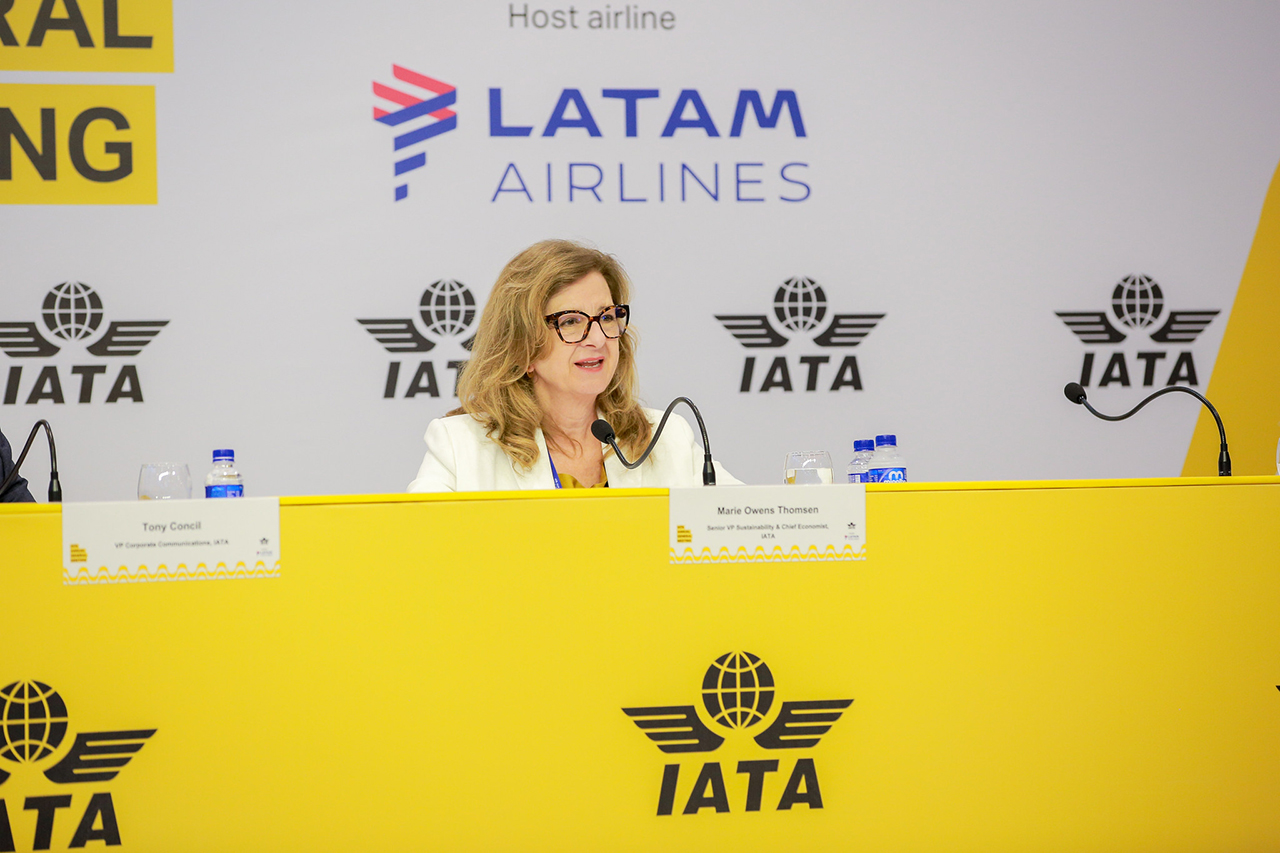
Aviation's Post-Crisis "Normal" Is Gone for Good, IATA Economist Warns
Tashkent, Uzbekistan (UzDaily.com) — The global aviation industry should abandon any expectation that air travel patterns, traffic flows, and market shares disrupted by the war in Iran will simply snap back once hostilities end, the International Air Transport Association's chief economist said Saturday — drawing on a broader conviction that no crisis in aviation history has ever truly reversed itself.
Speaking at an IATA media briefing on the sidelines of the association's annual general meeting in Rio de Janeiro, Marie Owens Thomsen, Senior Vice President for Sustainability and Chief Economist, offered a blunt assessment for carriers, investors, and policymakers counting on a return to the pre-February 2026 status quo.
"I don't really know why, as human beings, we insist in talking about how things are going to go back to normal, because they never do," Owens Thomsen said. "Every crisis brings with it a certain amount of permanent impact. And then the next crisis comes, and the next crisis comes, and it just sort of layers like a thousand-layer cake."
Middle East Traffic Will Not Fully Recover
The most immediate application of that thesis is the Middle East itself. Since air strikes on Iran and retaliatory actions effectively closed the Strait of Hormuz on Feb. 28, Middle Eastern airlines have lost roughly 60 percent of their revenue passenger-kilometres, according to IATA data for March and April 2026. The region, which had consistently generated some of the strongest profitability in global aviation, is now projected to post a net loss of US$4.3 billion this year.
Yet the deeper damage, in Owens Thomsen's view, is structural rather than cyclical. The Middle East's carriers commanded more than 40 percent of global connecting traffic before the crisis. On the key Asia-Pacific-to-Europe corridor alone, their share of satisfied demand has already fallen from 26 percent to 13 percent, replaced by European and Asian competitors who stepped in to absorb diverted passengers.
Owens Thomsen argued that a significant portion of that traffic will not return even if peace comes tomorrow.
"Should we have instant peace in the Middle East? Now people have already started to develop new habits," she said. "Of course nobody is going to necessarily want to continue to fly 20 percent longer routes if they can help it, but some of the traffic that has reorganized will not come back to the Middle East, I would argue."
The reason, she explained, is economic: rebuilding a lost route is far more expensive than defending an existing one.
"Once you've destroyed a route, so to speak, it takes a lot more money to try to get that route back," she said. "I think it would be a challenge for them, at least, to recuperate the shares of global traffic that they had before this crisis — not saying ever, but I think that would take longer than what most people would expect."
A Network That Reconfigures Instantly — and Permanently
Owens Thomsen used the crisis to illustrate what she described as a broadly misunderstood feature of global aviation: the network responds to disruption instantaneously, and those reconfigurations tend to stick.
"I think that this is something maybe that a lot of the general public does not really understand — how the global network reconfigures instantaneously in response to any crisis anywhere," she said. "No area of the global air transport network is insulated from the impact of trouble in any other part of the global network. And it ripples across the system."
That same logic applies to the benefits accruing to regions outside the conflict zone. Asked whether Latin America could capture some of the diverted traffic, Owens Thomsen said the gains from the Middle East's pain would spread beyond the most obvious beneficiaries — Europe and Asia — though unevenly.
"To the extent that we clearly observe that any impact anywhere in the global system does ripple — if you now have a region that is not catering to passenger demand as it used to, you could definitely make the argument that it will benefit everybody," she said. "The pain in the Middle East will benefit the other regions to some extent — most immediately Europe and Asia — and I would argue that some of it will even make its way to Latin America."
COVID Supply Chain, Now Hormuz: Crises Stack
Owens Thomsen situated the Hormuz shock within a broader pattern of compounding disruptions, arguing that the aircraft delivery crisis — itself a structural overhang of COVID-19 still unresolved in 2026 — was proof that the industry's baseline never returned to where it was before the pandemic.
"The supply chain disruption that we're still experiencing is an overhang of the COVID crisis," she said. "And it has not been resolved yet. It still lingers."
She used that precedent explicitly to dismiss the notion that elevated fuel prices would quickly normalise even if the Strait of Hormuz were reopened.
"I use that as part proof of our expectations that the consequences of this fuel crisis are also not going to suddenly vanish," she said. "I predict that prices will be higher. It won't take a long time to get back to the $60 a barrel of Brent that we had in January."
IATA's central scenario assumes an average Brent crude price of US$95 per barrel for 2026, a crack spread of US$57 per barrel, and a jet fuel price of US$152 per barrel — nearly 70 percent above 2025 levels.
Policy Fragmentation Deepens the Problem
The economist also widened her critique beyond the immediate crisis, arguing that a global retreat from coordinated economic and energy policy was itself compounding aviation's structural vulnerability — and would make future recoveries even harder.
"We're seeing this radical policy fragmentation, and that is impeding both current and future growth for all of us everywhere," she said, pointing to what she characterised as erratic US trade policy, Europe's turn inward, and Africa's inability to liberalise intra-continental air connectivity.
She argued that the most powerful tool available to governments seeking to foster growth was not monetary or fiscal stimulus — both severely constrained by high debt and inflation risks — but a serious commitment to the energy transition.
"The most efficient thing that people could do today to boost economic growth is actually to buy into the energy transition," she said. "If you adopt the energy transition as a state strategy and a vector for economic growth, and you combine that with using air connectivity as a vector for economic growth — well then you have a recipe for something that could be truly transformative."
The Industry's Slim Margin for Error
For the airlines themselves, the permanence of disruption carries acute financial implications. With a net profit margin of just 2 percent forecast for 2026 and balance sheets still carrying debt accumulated during COVID-19 — itself a crisis the industry had not fully recovered from before Hormuz — there is little cushion to absorb further shocks.
"Because of the long historic very low margins, airlines don't have particularly robust balance sheets," Owens Thomsen said. "If you can have crisis upon crisis upon these weak balance sheets, at some point the pressure is going to be unbearable."
She declined to predict specific airline failures but said the industry's structural fragility made the question of consolidation — and the regulatory constraints that restrict it in many jurisdictions — increasingly urgent.
"I would defend the airlines' self-determination rights," she said. "I would just want our industry to have access to that option to the same extent that other industries have."
IATA projects global passenger traffic growth of 2.1 percent in 2026 and net industry profit of US$23 billion, both roughly half what the association forecast in December 2025 before the Hormuz closure.