Stay up to date with the latest news
Subscribe to our telegram channel

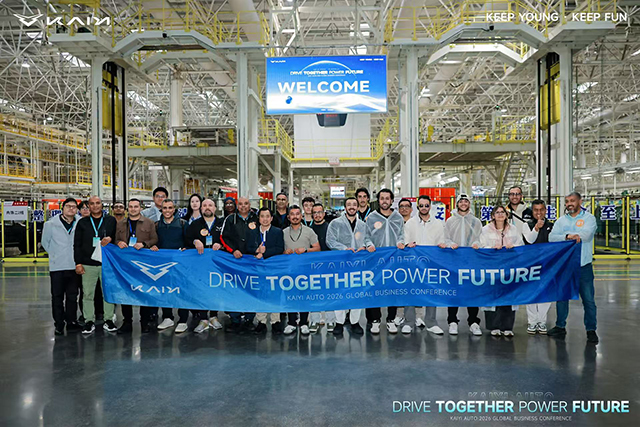
Inside the Machine: The Yibin Factory Building Every Kaiyi That Arrives in Uzbekistan
Tashkent, Uzbekistan (UzDaily.com) — The first thing you notice inside Kaiyi Auto's Yibin factory is the quiet. Not silence — the stamping presses cycle at 15 strokes per minute and the air carries the low hum of 114 autonomous guided vehicles threading the assembly floor — but the particular quiet of a space where human hands are largely absent from the production line itself. Robots weld. Robots paint. Robots transfer steel blanks from press to press. People watch, monitor, and intervene when the data says to.
Since April 2026, the vehicles coming off that line have been appearing in Uzbekistan — the first market in Central Asia to receive Kaiyi's full model range, including the newly launched X7 Hybrid seven-seat SUV. For Uzbek buyers, the Yibin plant is an abstraction: a number in a brochure, a factory tour video on a brand's website. For journalists who visited the facility during the company's 2026 Global Business Conference, it was something more tangible: almost an hour walk through the physical argument for why this brand deserves to be taken seriously.
THE SCALE OF THE PLACE
Kaiyi's Yibin campus covers 1,476,666 square metres in total — roughly the area of 200 football pitches. The first phase of construction, covering 648,666 square metres, is the active production zone. It houses four core workshops — Stamping, Welding, Coating, and Final Assembly — along with an R&D centre, a testing facility, and a dedicated PACK workshop for battery assembly. Products cover both conventional fuel vehicles and new energy models across every variant in the current lineup.
Through a programme of production line upgrades, coating workshop expansion, large-part sequencing improvements, and the construction of a new plastic parts workshop, the Yibin facility has raised its production rhythm to 60 jobs per hour across key lines. Current capacity stands at 350,000 complete vehicles per year, with a further 250,000 sets of plastic parts. A Phase II expansion is planned to bring total capacity to 500,000 units by 2027 and 800,000 by 2030.
"We began to do our business since 2014. In this process, we have attached great importance to brand building, to sales, and we know that there are so many different important elements. Quality is actually the cornerstone and the prerequisite of our sales. Without quality, there is no brand — and this factory is where that quality is made," Gao Lei, General Manager, Yibin Kaiyi Automobile Co., Ltd., said.
STAMPING: WHERE A CAR BEGINS
A vehicle's structural identity is established in the stamping workshop, and Kaiyi's is built around a 6,600-tonne synchronized high-speed stamping line — one of the largest configurations of its type in independent Chinese automotive manufacturing. The line pairs JIER press machines with Swiss GUDEL dual-arm automated robots to create a fully enclosed automated production environment capable of handling mixed steel-aluminium production.
The stamping workshop covers a gross floor area of 27,456 square metres, including 15,840 square metres of main workshop space and a 10,080 square metre parts warehouse. Maximum capacity is 300,000 vehicles per year at a production rate of up to 15 strokes per minute. The facility currently handles 95 parts across 65 die sets for six vehicle models; the introduction of the T16A and M1FA platforms will expand that to 155 parts and 106 die sets.
One detail that stands out to visitors: the line uses fully automatic die change and end-effector change technology, enabling a complete die changeover in under three minutes. In conventional stamping operations, die changes can take anywhere from 20 minutes to several hours. The three-minute standard is a meaningful competitive marker — it allows the line to switch between models with minimal downtime, which is operationally critical for a manufacturer running multiple platforms simultaneously. Line B is scheduled for single-machine tooling completion by 30 May 2026, with full installation and commissioning by 30 June.
WELDING: 314 ROBOTS AND COUNTING
The welding workshop is where the car's body takes its final structural form, and it is where the factory's automation density is most visible. The 60,000 square metre shop currently runs 314 robots — a figure that will rise to 360 following the M1FA platform upgrade — operating at a 73% in-house manufacturing rate. Automation rates vary by line: Line 11 runs at 66% automation, Line 12 at 36%, with both rates set to increase significantly post-upgrade.
The complexity of the welding operation is reflected in the weld-point counts for individual models. The X7 — Kaiyi's flagship SUV and the model now on sale in Tashkent — carries 4,196 weld points per body, the highest in the range. The E5 sedan requires 3,112 weld points; the X3 compact SUV 3,484; and the e-Qute 04 electric minicar 2,982. Each weld point is subject to automatic adhesive application and online inspection, vision-guided part gripping, group parameter control, and coordinate measuring machine measurement. The X7's Kunlun tailgate uses laser welding as a designated special process — a technique more commonly associated with premium European manufacturers.
Maximum capacity in the welding shop is 200,000 vehicles per year at current configuration, rising to 300,000 after the M1FA upgrade. Line 11 currently produces at 36 jobs per hour, targeting 40 JPH post-upgrade; Line 12 runs at 18 JPH, targeting 20 JPH after upgrade.
COATING: TWO WORKSHOPS, ONE STANDARD
Kaiyi operates two coating workshops at Yibin, serving different capacity and model requirements but applying the same quality standards across both.
Coating Workshop I covers 60,000 square metres and processes up to 240,000 vehicles per year at 42 jobs per hour. It currently handles five platforms and seven vehicle models, expanding to seven platforms and nine models with the introduction of the T16A and M1FA. Maximum body-in-white weight is 540 kg, with painting area specifications of 15 square metres for exterior topcoat, 8.5 square metres for interior topcoat, and 15 square metres for exterior clearcoat application.
Coating Workshop II adds 36,000 square metres and 100,000 vehicles per year at 20 JPH, with a larger maximum body-in-white capacity of 700 kg and a maximum pass-through dimension of 5,400mm — enabling production of larger MPV formats as the model range expands. The plastic parts workshop, at 5,600 square metres, runs at 250,000 sets per year and is capable of producing bumpers for all vehicle models in the lineup, with seven robots managing the painting process.
It is in the coating shop that the 0.1mm spraying accuracy figure most often cited in Kaiyi's marketing materials becomes operational reality. Visitors can observe the robotic painting arms working at speeds and tolerances that would be impossible to maintain manually — a consistency that directly affects the durability and finish quality of the vehicle over its service life.
FINAL ASSEMBLY: 275 STATIONS, ZERO SHORTCUTS
The final assembly shop spans 83,000 square metres and currently produces at up to 200,000 vehicles per year — a figure targeted to rise to 350,000 following the M1FA platform upgrade. The shop runs two lines with a combined 275 stations across Trim Line I, Trim Line II, a chassis line, a CP7 inspection line, and a modular workshop. Production rate on Line 11 is currently 40 jobs per hour, with Line 12 at 12 JPH; both are set to increase post-upgrade.
The assembly shop's engineering is designed for flexibility across powertrains. The lines carry flashing capability for ICE, PHEV, and BEV production simultaneously — a technical requirement that becomes increasingly important as Kaiyi's new energy vehicle share grows toward the 50% target set for 2030. The facility has also been equipped with an advanced intelligent driving calibration line and an EOL (end-of-line) aging test room, both of which meet the production requirements for vehicles with advanced driver assistance systems.
Automation in the assembly shop operates at a different level than in stamping or welding — more human hands are involved in fitting, fastening, and final checks — but the support systems are dense: 114 AGVs for automated conveying, 138 electric tightening tools, 18 power-assisted manipulators, and 282 sets of production and inspection equipment. Quality control at this stage covers 100% critical torque tightening, AI visual inspection of appearance and configuration, battery pack sealing inspection, and the EOL aging test.
"In Kaiyi, each person is a quality inspector. We are all held accountable for ensuring good quality. For our plants in and out of China, we follow the unified procedures, the same evaluation principles and the same processes. We conduct process and product reviews for our overseas factories regularly to ensure consistency — always," Yan Xiaodong, Chief Quality Officer, Kaiyi Auto, underlined.
THE TEST TRACK: WHERE DATA MEETS ROAD
Behind the production halls, Kaiyi operates an on-site vehicle testing and validation facility that is, in several respects, the most revealing part of the factory tour. It is where the company's quality philosophy stops being an organisational chart and becomes a moving car under stress.
The test circuit is designed to simulate the full range of conditions a vehicle will encounter across the global markets Kaiyi is targeting. Journalists visiting the facility from countries across Africa, Central Asia, the Middle East, Latin America, and Southeast Asia were given the opportunity to drive production-specification vehicles — including the X7, X7 Hybrid, E4 and E5 — through a structured sequence of road surfaces, gradient changes, and dynamic scenarios.
The circuit includes high-speed acceleration runs, emergency braking zones with both dry and variable-friction surfaces, a handling course with tight radius corners and lane-change sections, and a dedicated rough-road track comprising cobblestones, expansion joint crossings, deep pot-hole sections, Belgian block surfaces, and a washboard ripple strip. There are also incline tests and a water-wading section to validate sealing and drainage performance — directly relevant for markets such as Southeast Asia, where the company has validated a maximum wading depth of 450mm.
For the journalists behind the wheel, the exercise produced a consistent observation: the vehicles — particularly the X7 Hybrid — were notably easy to place and control across the full range of conditions. The steering weight and response felt calibrated for confident use rather than sporting sharpness; the suspension absorbed the rough-road sections with composure that belied the relatively modest price positioning; and the braking — including a number of hard stops from 80 km/h — was linear and predictable. The X7 Hybrid's 7.9-second 0-100 km/h figure, powered by the Kunpeng hybrid system, was easily reproducible from a standing start, with none of the hesitation or inconsistency that sometimes characterises plug-in hybrid launches in lower-specification systems.
The test track experience is not incidental to Kaiyi's brand strategy — it is deliberate. Every new model is required to complete at least two full years of extreme-environment road testing with cumulative mileage exceeding one million kilometres, including high-temperature tests at 50°C+ in the Middle East, extreme cold testing at -30°C and below in Kazakhstan and Russia, high-humidity validation in Southeast Asia, and high-altitude testing in the Andes above 4,000 metres. What journalists drive on the Yibin circuit is, in that sense, the end product of that testing programme made available for independent verification.
WHAT IT MEANS FOR UZBEKISTAN
When a Kaiyi X7 Hybrid is delivered to a buyer in Tashkent, it has passed through all four of those workshops, through the 275-station assembly line, through EOL testing, and through the validation programme that underpins the company's zero-defect quality target. It has been welded at 4,196 points, painted to 0.1mm accuracy, and assembled on a line where 78% of processes are automated.
Whether that translates into the long-term reliability and after-sales support that Uzbek buyers reasonably require from a new brand remains a question that years of market presence, not factory tours, will answer. But as a manufacturing argument — as a response to the question of whether a relatively young Chinese brand has the industrial foundation to compete with established global players — the Yibin plant makes a case that is difficult to dismiss.
Kaiyi's 2030 plans call for this facility to eventually supply a global network spanning 100 markets and 1,000 outlets, with overseas capacity supplemented by eight CKD and 15 SKD factories in markets including Kazakhstan, Egypt, Indonesia, Brazil, and Belarus. Uzbekistan, as the site of the X7 Hybrid's global debut, sits at the beginning of that supply chain — closer, geographically and logistically, to Yibin than almost any other international market the company serves.
"We believe that without the overseas market, there will be no good making of Kaiyi Auto. We need to respect the rules for market expansion overseas. We need to tell very good brand stories. And we need to grow together with our partners. The factory in Yibin is where that story starts, "Gao Lei, General Manager, Yibin Kaiyi Automobile Co., Ltd., stated.