Stay up to date with the latest news
Subscribe to our telegram channel

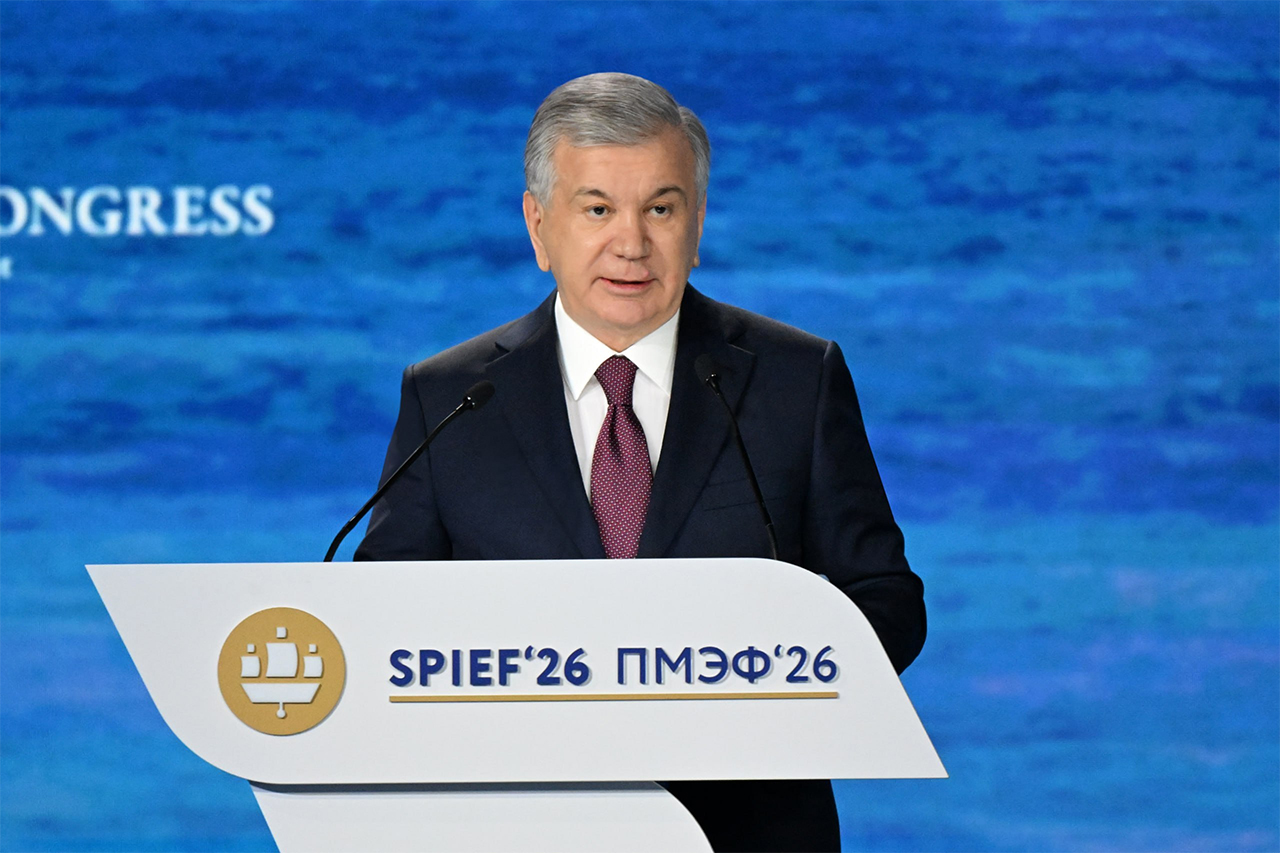
Mirziyoyev at SPIEF 2026: Uzbekistan-Russia Trade Hits $13B, $50B Project Portfolio Unveiled
Tashkent, Uzbekistan (UzDaily.com) — Uzbekistan President Shavkat Mirziyoyev said Friday that bilateral trade with Russia has more than tripled over the past decade from $4 billion to $13 billion, and unveiled a series of sweeping initiatives aimed at deepening Eurasian industrial, digital and humanitarian integration, addressing the St. Petersburg International Economic Forum.
Mirziyoyev's speech, delivered before an audience of heads of state, government officials and global business leaders, stood as one of the forum's most substantive addresses on Central Asian affairs. The president systematically presented the results of a decade of economic reforms, outlined strategic targets through 2030, and proposed concrete mechanisms for cooperation with Russia and a broader circle of international partners.
Trade and Investment
Mirziyoyev said the joint project portfolio with Russia now exceeds $50 billion, with interregional projects totaling $5 billion and a further $5 billion investment package in the pipeline. Moscow and St. Petersburg, the Moscow and Leningrad regions, Tatarstan, Bashkortostan, Krasnoyarsk and Perm territories are all actively involved in the bilateral cooperation, he said. The partnership spans energy, chemicals and petrochemicals, engineering, agriculture, logistics, and the textile and food industries. Among flagship projects, Mirziyoyev highlighted joint industrial parks in five regions of Uzbekistan and the creation of a railcar manufacturing cluster in Tashkent.
In a broader investment context, he noted that more than $150 billion in foreign investment has entered Uzbekistan since reforms began, thousands of modern enterprises have been launched, and exports of goods and services have grown almost threefold.
Eurasian Belt of Technological Industrialization
The centerpiece of Mirziyoyev's address was a proposal to establish an "Eurasian Belt of Technological Industrialization" — a network of interconnected industrial and technological clusters linked through a unified digital platform for industrial cooperation. The initiative, as envisioned, would cover the full production cycle from technology development and personnel training to the localization of industrial output and access to export markets. Mirziyoyev proposed anchoring it in the Innoprom. Central Asia innovation and industrial exhibition held annually in Tashkent, which he said would allow businesses to find partners and forge mutually beneficial ties directly.
Energy and Nuclear Cooperation
The president devoted considerable attention to the energy agenda. Uzbekistan has expanded electricity generation by 50 percent, from 58 billion to 87 billion kilowatt-hours, through investment projects that include Russian participation, he said. The country plans to reach 120 billion kilowatts by 2030, with 54 percent of that capacity coming from renewable sources.
The most symbolically significant development of the week came a day before the forum opened, when Mirziyoyev joined Russian President Vladimir Putin at a ceremony marking the pouring of first concrete at Uzbekistan's first nuclear power plant, being built with Russian participation. The president described the project as a long-term investment in national development, the training of a new generation of engineers, and the mastery of advanced technologies. Uzbekistan also plans to cooperate with Russia in other peaceful applications of nuclear technology, including medicine, agriculture, industry and science.
Digital Ecosystem
On the digital front, Mirziyoyev argued that digital platforms have become the new language of the economy and the new form of infrastructure, on a par with roads, pipelines and power lines. He said sales of Uzbek goods through Russian marketplaces and digital services have grown 3.5-fold over several years, surpassing $1.5 billion.
To build on that momentum, he proposed creating a joint digital ecosystem encompassing the harmonization of digital trade regulations and urban services, mutual platform promotion of Uzbek and Russian brands, the creation of a unified digital employment profile, and the development of artificial intelligence products. This, he said, would open new markets for business and new income opportunities for citizens.
Human Capital and Education
Mirziyoyev addressed human capital as a standalone strategic priority, noting that more than half of Uzbekistan's population is young. The country hosts 32 branches of foreign universities, of which 15 are Russian — what he described as Russia's largest university network abroad. He pointed to the first joint engineering schools in Almalyk and Tashkent as successful models of practical professional education.
To systematize efforts in this area, Mirziyoyev proposed establishing a joint online human capital development platform combining educational programs, language and IT courses, support for young entrepreneurs, and access to employers. He expressed hope that President Putin would back the initiative and proposed directing relevant ministries to launch the platform as quickly as possible.
Macroeconomics and the 2030 Strategy
Summing up a decade of reform, Mirziyoyev said the size of Uzbekistan's economy has grown from $50 billion to $147 billion. Growth in 2026 is projected to exceed 8 percent. Household incomes have grown 2.5-fold over the past five years. Under the Uzbekistan 2030 development strategy, the country aims to expand the economy to more than $240 billion, shift all sectors to a model of technological and innovation-driven growth, and raise household incomes to above-average levels. The president stressed that growth must be not only fast, but sustainable, inclusive and oriented toward improving quality of life.
Financial Markets and the Tashkent IFC
On financial market development, Mirziyoyev announced the creation of the Tashkent International Financial Centre, to operate under a special legal and tax regime offering investors reliable guarantees and convenient instruments. Sovereign and corporate bonds placed by Uzbekistan on international markets in recent years have reached a cumulative $16 billion. Last month, Uzbekistan's National Investment Fund, which consolidates the assets of the country's largest state companies, completed its first public share placement on the London Stock Exchange. The president also noted that Uzbekistan climbed a further 14 places in the Index of Economic Freedom in 2026.
Mirziyoyev invited forum participants to the Tashkent International Investment Forum, scheduled for June 16–18.
Tourism and the Humanitarian Dimension
On the humanitarian track, Mirziyoyev framed tourism as what he called the "economy of trust." Nearly one million Russian citizens visited Uzbekistan in 2025, he said, and Uzbekistan is prepared to receive even more this year. He proposed launching a creative and tourism corridor "From Samarkand to St. Petersburg," encompassing joint art and film festivals, museum exhibitions, gastronomic weeks and music events. He noted that cultural projects representing Uzbekistan had already launched at the Mariinsky Theatre and the Hermitage the previous day. By 2030, the creative economy's share of GDP is targeted at 5 percent.
Historical Ties
Opening his remarks, Mirziyoyev drew on the deep historical ties between the two nations, recalling that during World War Two Uzbek citizens participated in the defense of Leningrad while Tashkent received more than 1.5 million evacuated children, women and elderly. That historical framing set the tone for an address in which the president repeatedly described Russia as a "time-tested strategic partner and ally."
The forum is being held under the motto "Pragmatic Dialogue as the Path to a Stable Future." Tanzania President Samia Suluhu Hassan and Chinese Vice President Han Zheng are also attending.